
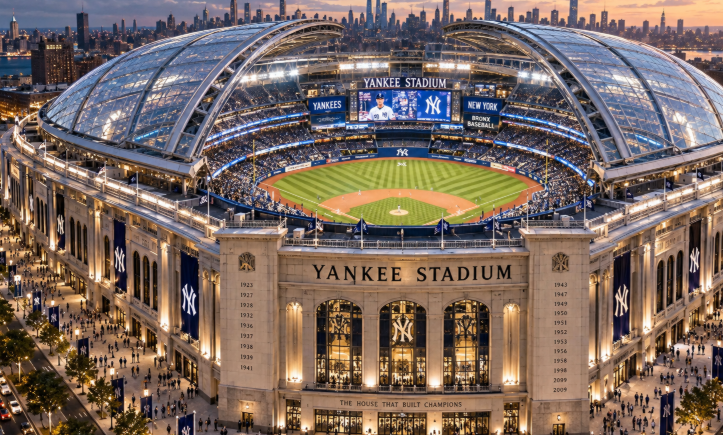
NEW YORK, New York — In a groundbreaking hypothetical investment scenario, the New York Yankees announce a $1.8 billion renovation plan for Yankee Stadium, aimed at modernizing one of the most iconic landmarks in American baseball.
At the heart of the project is an automated retractable roof system that can open and close depending on weather conditions, helping minimize games delayed or canceled due to heavy rain.
The idea stems from the challenges the Yankees have experienced throughout the season, when unpredictable weather in the Bronx repeatedly disrupted the schedule and affected fans.
With a modern retractable roof system, the stadium would be able to host games under a wide range of weather conditions while protecting spectators from heavy rain and extreme temperatures.
The project is expected to incorporate smart control technology, allowing the roof to close automatically when rain is detected and reopen when outdoor conditions become favorable.
However, the project's most important objective goes beyond technology, focusing on preserving the historic identity that has been associated with the New York Yankees for generations.
The current Yankee Stadium opened in 2009, carrying forward the legacy of the original stadium built in 1923, which witnessed legendary figures such as Babe Ruth, Lou Gehrig, and Mickey Mantle.
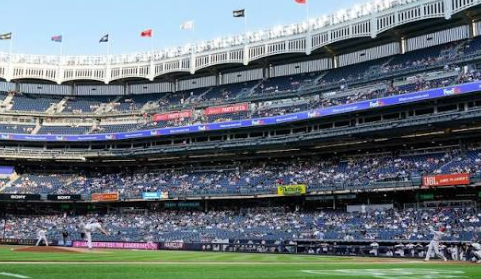
Therefore, every architectural modification in the plan is intended to preserve the stadium's distinctive classical beauty, particularly its limestone facade and design elements reminiscent of the original Yankee Stadium.
The retractable roof system would be designed to blend seamlessly with the existing architecture, minimizing any impact on the stadium's traditional appearance.
In addition to the roof, the plan also includes upgrades to seating, sound systems, display screens, and spectator service areas.
Restaurant spaces, entertainment areas, and hospitality suites would also be expanded, transforming Yankee Stadium into an attractive destination even outside the MLB season.
A special area would be dedicated to honoring the Yankees' 27 World Series championships and the legendary figures who helped build the franchise's legacy.
There, fans would be able to experience historic moments through advanced display technology, connecting the past with future generations of players.
For New York City, the project could deliver significant economic benefits through tourism, job creation, and commercial activities throughout the Bronx area.
Reducing weather-related postponements would also help protect the game schedule, television revenue, and the experience of millions of fans.
In particular, automated retractable roof technology could help the Yankees maintain more consistent playing conditions during crucial postseason games in October.
However, a $1.8 billion investment would require an extremely complex process of financial evaluation, engineering assessments, and construction planning.
Under the hypothetical proposal, construction would be divided into multiple phases to minimize disruptions to the Yankees' home games.
The ambition behind the project is not to transform Yankee Stadium into an entirely different ballpark, but to bring the Bronx's historic landmark into a new era of technology.
If implemented, this renovation could become one of the most remarkable stadium projects in MLB, where more than a century of Yankees tradition would continue to be preserved within a modernized setting.