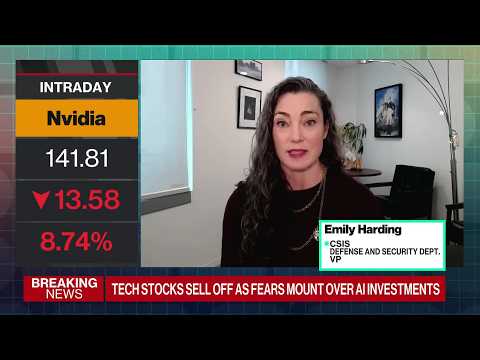
Global equities opened firmer after another violent U.S. session, with the AI trade leading a tentative rebound even as U.S. cash markets stayed shut for Thanksgiving. European benchmarks and U.S. stock futures pointed higher, copper bounced from an 11-month low, and strategists split between calling the move a reset and warning that it was another sell-the-rally.
The bounce mattered because it arrived with lighter U.S. participation, unresolved export-control risk around Nvidia, and a live argument over whether AI spending can still carry growth. Bonds, oil, tariffs, and a Brussels summit sat alongside the equity story.
Why are stocks higher if the last U.S. session was so volatile?
On Bloomberg’s Opening Trade, anchors described Wednesday’s U.S. session as another sharp swing, with chip shares still under pressure into the close and the S&P 500 ending only slightly lower after deep intraday chop. Nasdaq futures were then indicated higher, and European futures followed. Later in the morning, the broadcast described broad gains, with Germany stronger than the FTSE 100 and technology among the better sectors.
The holiday was part of the setup. There was no cash trading in U.S. stocks or Treasuries. Neil Campling, a Bloomberg senior strategist, said the prior session had not looked like a normal pre-Thanksgiving day. Volumes are often about 20% below average; he said they ran about 20% above it. He also said a large U.S. trading desk saw international hedge funds driving heavy selling early, then an unusual burst of programmed buying later as traders used the dislocation.
That is a rebound driven by flows and positioning, not a clean all-clear on earnings or policy.
Is this the end of the AI scare or another head-fake?
Campling’s answer was that buyers are stepping into dislocations, but the argument has not changed: markets are repricing the rate of growth, not abandoning AI. He tied the uncertainty to regulation and to Nvidia, and said investors would wait for Jensen Huang’s crowded Washington week—closed-door meetings, congressional testimony, and a keynote—before judging the next leg.
A Financial Times report that Nvidia was halting chip shipments to Southeast Asia sharpened that risk. Campling said server partners, including Super Micro and Dell, could be affected while export controls are sorted out, and he cited Super Micro as having about 15% of revenue running through Asia. The knock-on, he argued, is not a simple swap to other U.S. chips, because the controls reach other American suppliers as well. If a region that supports very high projected growth becomes harder to serve, the AI “growth trade” is the asset at risk.
Adam Linton of Bloomberg’s MLIV team was similarly unconvinced that Thursday was an inflection. He noted that AI infrastructure, cloud computing, and Nvidia had still looked weak in the prior U.S. session—Nvidia was described as closing down about 5%—and that each rebound this month had faded. Confidence, he said, is low even among investors who still like the long-term story.
Who is buying the dip, and who wants to sell the rally?
Ella Gude, head of investment strategy and asset allocation at BNY Investments, took the other side of the reflexive bounce. She said the signals she watches have looked more like stagnation than a quick return to expansion. Stagnation regimes, in her framework, tend to be poor for equities and better for bonds and commodities, and they do not easily flip back into expansion.
She put the market-implied probability of recession around 20% and said markets could test higher odds even if that is not her base case. The logic was the wealth effect: AI-linked gains have been a large part of U.S. growth and household spending, so a deeper equity drawdown could force a policy response. Bonds, she argued, offer yield and asymmetry after lagging other assets, but they are not an easy hedge if the Federal Reserve stays restrictive.
A portfolio manager later on the program was also short of comfort. Positioning had not reached panic, hedge funds had cut exposure, and “neo-cloud” debt models remained a stress point. The catalysts he wanted were prosaic: evidence that data-center growth continues without project moratoriums, proof that AI is raising returns, and clearer news on Chinese competition in semiconductors.
Can the AI bill actually be paid?
Eduardo Lecubarri, global head of small- and mid-cap strategy at J.P. Morgan Research, argued that the spending will happen whether or not every investor likes the social consequences. He dismissed the idea that politics would simply switch the build-out off, and said funding was not the constraint: on his figures, about 40% of AI capital expenditure is being done by cash-flow-positive companies, and 81% by companies averaging just 0.13 times leverage.
His return math was deliberately simple, and it should be read as his case, not a settled accounting identity. He said spending so far of about $0.8 trillion, set against an S&P 500 net margin he put at 35%, implies roughly $500 billion of sales—about 0.4% of a $20 trillion global economy. He then argued the world would pay that for AI’s benefits, and that spending on the order of $1.8 trillion a year could run to the end of the decade.
The more useful distinction was where to own it. Lecubarri separated AI users and enablers—IT services, cybersecurity, and firms using AI to improve a service—from stocks whose entire valuation depends on how long and how large the capital-spending supercycle lasts. In the second group, he said, investors do not know normalized revenue or earnings, so they do not really know the multiple they are paying.
Why might small and mid-caps matter if the hyperscalers wobble?
Lecubarri’s small- and mid-cap pitch was a crowding argument. With passive money concentrated in large caps, he said, any question mark in big tech turns into a stampede. By contrast, he said 81% of AI-related stocks account for only 9% of market cap, which is a way to keep the theme without owning only the most crowded names.
He also pushed back on the idea that higher rates automatically break smaller companies. A larger share of small-cap debt is floating-rate, but he argued the next few years will not replay the shock of rates jumping from near zero. Large companies still have fixed-rate debt to refinance. His condition was modest: the call works if rates do not gap by something like 300 basis points.
Europe, in his view, is not the center of the AI capex boom, but it offers hardware, enablement, and lower multiples—he cited 14 times earnings for some of those names. That is a relative-value claim, not a claim that Europe has replaced the United States or Asia as the core of the trade.
What does copper’s bounce say about AI demand?
Copper was the cleanest cross-check on screen. The broadcast said the metal jumped off an 11-month low and that basic resources led Europe, with the move tracking tech. Bloomberg’s mining reporter treated that as sympathy with equities, not a new fundamental bid.
The reporter said prices had reached a record near $5,000 a ton in September on the data-center story, then were pulled down with the AI trade. Even after Thursday’s bounce, the month still looked like one of the worst in 10 to 15 years if prices stayed near current levels. Few people the reporter had spoken to were calling a durable low. A strong dollar and the prospect of steeper rate hikes were additional weights.
The signal, the reporter argued, runs more against copper than against AI itself. The market is recalibrating how much metal the build-out really needs, and whether last year’s price already assumed too much. Anchors also noted a more benign diesel-price picture and its possible inflation implication, while oil was firmer on the day. One on-air reference put crude near $94 a barrel and still close to $95; that level should be treated as the broadcast’s quote, not an independently verified settlement.
Are tariffs still a sideshow to the AI trade?
Not entirely. The program said the Trump administration was rolling out further tariffs after the Supreme Court struck down some earlier country-by-country measures, and that many proposed rates resembled deals reached last year—China was cited at 20%, with higher “potential” rates if talks broke down. President Trump has called tariffs a favorite tool, and the anchors framed the move as a reminder that the policy has not softened despite political pushback.
China’s Commerce Ministry was quoted as staying in close contact with Washington on extending the truce and as unlikely to retaliate if the new duties stayed inside that deal. Europe’s interest in retaliation was described as muted for now. India, Vietnam, Singapore, and Japan were cited as still trying to renegotiate. The equity impact is second-order until a partner actually answers, but the policy floor under the AI supply chain—export controls on one side, tariffs on the other—is still moving.
Kevin Hassett, speaking to Bloomberg, offered the White House gloss: a “Goldilocks” mix of high growth, low unemployment, and inflation heading back toward target. Gude’s stagnation call and a later guest’s warning that markets have been complacent about sticky inflation and a strong job market are the direct counterweight. The broadcast did not settle whether the next Fed move is a hike, a hold, or renewed cuts.
What else moved the risk mood?
Several items sat outside the index futures but fed the same “what is priced” question.
The Wall Street Journal was cited on Situational Awareness, the hedge fund founded by Leopold Aschenbrenner. The fund reportedly lost 65% after fees in the third quarter on highly leveraged AI bets, yet was still up nearly 89% for the year through September. Aschenbrenner was said to be taking a more measured approach to risk. That is a positioning story: leverage amplified both the boom and the air pocket.
The Federal Communications Commission was reported to have approved a SpaceX request to launch orbital data centers, with Elon Musk’s company planning as many as one million satellites. The same report said the plan relies on unproven technology. SpaceX has pitched satellites as a cleaner alternative to land-based facilities; scientists warned about crowding Earth’s orbit. If the AI power and land constraint is real, orbit is now part of the capital-spending narrative—and part of its execution risk.
In the Middle East, Saudi Arabia said Yemen’s Houthis launched strikes on Red Sea ports, with minor damage from a projectile and a drone intercepted near Jeddah Islamic Port. The Houthis called the attacks retaliation for Saudi strikes. Oil’s firmer tone sat next to that headline, though the program did not pin the price move on the strikes alone.
Is UniCredit’s Commerzbank push a finished deal?
The broadcast was not internally consistent, so the status should not be smoothed into a single fact. Early segments said UniCredit had asked Commerzbank to call an extraordinary general meeting, wanted to overhaul the supervisory board, and proposed chief executive Andrea Orcel as chair, after describing final regulatory approval for one of Europe’s largest cross-border bank deals in decades. Later, a correspondent covering the story called the purchase completed and described a balance sheet of about €1.5 trillion, a bigger German presence, and a Polish bank attached.
What is safe to say is that the program treated the combination as a watershed for European bank M&A: a deal long opposed in Germany, pursued across borders, and now being used in boardrooms as proof that hostile cross-border takeovers can get through. The correspondent said bank shares had risen sharply last year and were still up for many names this year, which usually supports deal activity, and that a softer regulatory package from Brussels could matter next year. He also said tech valuations could still wreck the market window for that kind of transaction.
Why is Brussels meeting while markets bounce?
European Union leaders gathered in Brussels with no expectation, according to Richard Bravo, of settling the next long-term budget in one sitting. “Frugal” net contributors want a smaller budget; recipient countries do not. The real deadline he described was the December summit.
Ukraine financing is tied into that fight. Germany, he said, wants budget money linked to support for Ukraine, which has angered governments such as Slovakia and Hungary that have carve-outs from the EU loan. No concessions were reported. Leaders were also expected to move, around lunchtime, toward a vote on who succeeds Christine Lagarde at the European Central Bank, with confirmation hoped for later in the day. A Bank of England monetary-policy account and the ECB’s meeting account were on the data slate, but the U.S. holiday removed the usual American macro prints.
Canada’s finance minister, also cited on the program, used the trade-war backdrop to argue for a more diversified, less U.S.-dependent economy. That is the same political weather as the tariff segment: partners stay at the table, and build alternatives at the same time.
Where does European venture capital fit?
The tech rebound had a private-market echo. Plural co-founder Taavet Hinrikus, also a co-founder of Wise, discussed a new €1 billion early-stage fund, one of the largest of its kind in Europe. He said fundraising was not the hard part for his firm—U.S. money is available—but that Europe still invests too little of its own pension and savings capital in venture.
His examples were deliberately non-consensus: a nuclear-fusion venture that he said had raised about half a billion this year, plus AI chips, space, and healthcare tools such as computer vision in hospitals. He argued Munich, the Netherlands, and other hubs are producing deep-tech companies that can stay independent rather than sell immediately to U.S. buyers. He also welcomed public scale-up capital only if it is run by investors rather than by bureaucracy. Exits, he said, matter less than they used to for institutions that can trade stakes before an IPO; retail investors are the group left out.
What would turn this bounce into a trend?
Mark Cudmore’s bullish case was that fundamentals had improved—data beating forecasts, earnings holding up, yields and energy lower—while equities had already suffered a large drawdown from September highs to recent lows. He described that gap as close to $20 trillion in global market value and said several Asian markets now looked discounted enough for long-term buyers. He also conceded the tape: Asian volumes were light, the bounce subdued, and some investors appeared to be selling other holdings to fund Nvidia and private names such as Anthropic. His catalyst was thin holiday positioning. When desks return, he argued, they may decide the selloff outran the economy.
The other camp wants evidence, not a calendar effect. Campling wants Huang’s week and clarity on Southeast Asia shipments. Gude wants markets to stop assuming an easy return to expansion. Lecubarri wants investors to own AI where the denominator is knowable. The mining desk wants copper buyers who are not just chasing a one-day equity bounce.
Thursday’s climb showed that buyers still exist. It did not show that they will stay once U.S. cash markets reopen and the next Nvidia, Fed, or Brussels headline lands.