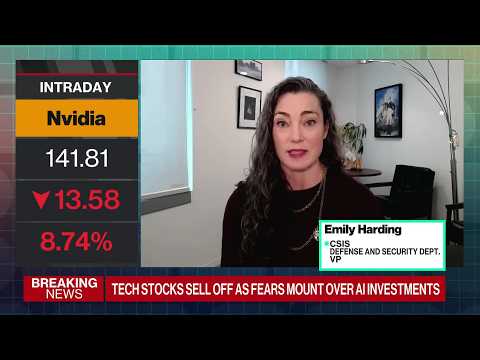
Nvidia remains the company most analysts associate with “sovereign AI,” the push by governments to keep advanced computing inside their own borders. In a televised interview, one market analyst argued that the chipmaker is still better placed than rivals to supply that demand, but that shareholders will not treat strategic importance as a substitute for clearer governance around Jensen Huang.
The discussion mixed three issues that markets often price together: leadership succession, an unresolved probe that the speakers said would drag into further hearings, and the risk of a wider U.S.–China technology rupture. None of those points was presented as a settled finding. They were judgments about confidence, and the transcript does not spell out the underlying allegations.
Why do some investors want a succession answer even if Huang plans to stay?
The opening question was blunt. Would it restore confidence if Huang had not suggested that no succession plan is needed?
The analyst treated that as only part of the problem. The practical worry, he said, is what happens if something happens to Huang. He accepted that Huang believes he will run Nvidia for some time and wants to do so, and he called that “probably true.” He did not treat longevity as the same thing as a governance plan.
Huang’s reported view, as relayed in the exchange, is that Nvidia is different. The analyst disagreed. Other companies, he said, also run relatively flat organizations, and he named Apple as one example. Flat structure, in that reading, does not remove the need to think about a post-Huang Nvidia.
He tied the issue to the board as well. With another addition to the board, possibly in a chair or similar role, he expected more attention to what follows Huang. That is a governance comment, not a claim that a successor has been chosen or that Huang is leaving.
Does an unfinished probe matter if political leaders say there was no wrongdoing?
The interviewer noted that President Trump has personally said he thinks there has been no wrongdoing. The same speaker then called the inquiry the shortest and shallowest investigation in history and said there was still “a lot of wood to chop,” including further investigation, hearings, and possibly more hearings if Democrats take control of Congress in January.
Those lines are commentary from the broadcast, not a court record. The transcript does not describe the facts under review, the agencies involved, or any formal finding. It also does not establish that Democrats will control Congress; it treats a January majority as something “we know,” which readers should treat as the speaker’s premise, not as verified election math from this source.
The analyst’s market point was narrower. Uncertainty is real, he said, and it is not unique to Nvidia. Across the technology trade he sees fewer convictions and more questions than answers rolling into next year and into 2028. This episode “doesn’t help.” He expects some answers, not all of them, and he expects investigations and reporting to continue. His prescription was a return to “as stable a state as possible.”
Even a full clearance, the interviewer argued, can leave questions hanging over the stock in the meantime. The analyst did not dispute that. He said the trade needs several narratives to firm up, “not just Jensen and Nvidia.”
Is Nvidia “too big to fail” in the U.S.–China technology contest?
Asked whether Huang and Nvidia were simply too critical a piece in the U.S.–China strategic contest, and whether that is why the president intervened, the analyst said, “We think so.”
His reasoning ran through sovereign AI, not through a detailed account of any intervention. He said this administration has talked about the importance of sovereign AI, and that many nations will do the same. His long-standing view is that the real supplier in that story is a merchant GPU vendor—Nvidia, or AMD—not a U.S. hyperscaler building its own compute and calling that sovereign AI.
On that definition, localized compute for cybersecurity and national defense favors whoever sits at the frontier. He said Nvidia is that champion, and that “everybody would agree” Huang at the helm is the best-positioned version of that champion. That “everybody” is his characterization. It is not a survey, and AMD remains, in his own sentence, the other merchant-GPU candidate.
He was explicit about the limit of the argument. Strategic importance does not erase the questions that still have to be answered before there is confidence in both Huang and Nvidia as a sovereign-AI play.
Could China policy turn a company story into a chip war?
The interviewer pushed the timeline out: questions lingering well into 2027, Democrats entering Congress with a majority on January 3, and China hawks on both sides of the aisle. He asked whether the issue is bigger than Huang and Nvidia, and whether the risk is U.S.–China trade tension or even a “trade war 3.0.”
The analyst’s concern was a “full chip war,” a phrase he used for lack of a better term. He said that would be very painful because the U.S. compute ecosystem depends heavily on inputs that come out of China. Cutting those off, he said, would be disastrous for many companies.
He also noted that U.S. firms are still allowed to sell leading-edge components into China that are not GPUs. Policy, in his view, has to draw lines: where convictions are firm about what may go to China, and where they are not. A full cutoff, he argued, would probably produce the chip war that officials do not want, because they know how dangerous it would be for U.S. companies and for semiconductors.
That is an economic-dependence argument, not a forecast that such a cutoff will happen. The transcript contains no export-control percentages, no revenue exposure, and no list of restricted parts.
What can investors actually take from the exchange?
The usable claim is conditional. On the analyst’s definition of sovereign AI—national buyers wanting frontier compute from a merchant GPU supplier—Nvidia is in the strongest seat, with AMD as the other named contender, and Huang’s personal role is treated as part of that advantage.
The same speaker refused to stop there. Confidence still requires a more credible answer on life after Huang, and it still requires the probe and the reporting cycle to move toward something more stable. He placed both inside a wider technology tape that he already sees as short of conviction into 2028.
Readers should separate three layers. The strategic-positioning view is the analyst’s. The description of Trump’s “no wrongdoing” remark and of coming congressional hearings is the interviewer’s framing, with the allegations themselves unspecified here. The chip-war warning is a scenario about supply-chain pain, not a documented policy decision.
Until those layers are filled in by primary documents—board disclosures, formal investigative outcomes, and actual export rules—the sovereign-AI bull case and the governance discount can coexist. That tension, more than any single quote, is what the interview left on the table.
This article is based solely on commentary in the cited broadcast. It does not independently verify allegations, political control of Congress, or Nvidia’s board or succession arrangements.