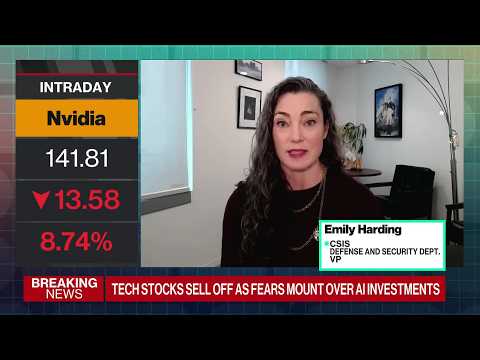
Global technology shares were under pressure again on Wednesday, November 25, as a short-lived rebound tied to Nvidia faded and investors returned to questions about artificial-intelligence spending, margins and funding. On Bloomberg’s The Opening Trade, Nasdaq futures were described as down about 1.5% to 1.7% early in the program, then closer to 2% and, at one point, 2.3%, before later easing to about 1.9% off the lows. European futures were comparatively resilient, leaving a split between a shaky U.S. tech tape and a steadier open in Europe.
The distinction matters. The price action was reported as fact by the anchors; the argument that it signals a lasting break in the AI trade was opinion from strategists, and they did not agree with one another.
Why did the Nvidia bounce fade so quickly?
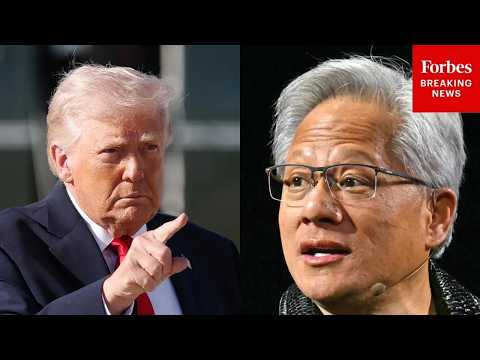
Anchors Anna and Guy said Nasdaq futures had “round-tripped” the bounce that followed remarks associated with Nvidia chief executive Jensen Huang. Asian equities were also lower. Taiwan and South Korea were described as being in bear-market territory, with authorities taking steps to limit selling. Anthropic was cited on air as trading below its IPO price, which the anchors treated as another sign that risk appetite had not stabilized.
Bloomberg senior strategist Neil Campling argued that positioning, not a clean change in fundamentals, was driving the near-term tape. He said Friday’s liquidation, Monday’s sharp bounce and Tuesday’s renewed tech selling showed short covering and reductions in gross exposure. He also said he saw little evidence that investors wanted to add risk ahead of a heavy Nvidia-related week in Washington after the Thanksgiving holiday.
Campling pointed to several chip-sector data points: Goldman Sachs had cut SK Hynix operating-profit estimates by about 23% earlier in the week; TrendForce had lowered NAND price targets; and Micron and Analog Devices had been downgraded after disappointing forecasts. Those are his characterizations of outside research, not results released during the broadcast.
What did Dell’s results say about AI server demand?
Dell was the clearest company-level test discussed on the program. Campling said the AI-server business had grown 198% year on year and that investors were focused on a bullish forecast. He argued, however, that the report was not unambiguously strong: AI servers carry only single-digit margins, so rapid revenue growth can pressure profitability.
He also highlighted backlog. Of a figure he put at roughly $135 billion, about $100 billion related to AI servers, and he said a large portion could be exposed to so-called neoclouds—newer cloud operators that he described as more vulnerable if funding tightens or growth slows. His key unanswered question was how much of that backlog customers can cancel. The broadcast did not answer it.
Are new U.S. tariffs about to return?
Trade policy was the second live risk. Bloomberg reported that the United States was preparing another round of tariffs covering China, the European Union and roughly a dozen other economies, possibly as soon as that day. Anchors linked the move to an excess-capacity investigation that could affect 16 economies, including the EU, Switzerland and Norway.
Bloomberg’s Jill Disis framed the preparations as an effort to rebuild a tariff regime after the Supreme Court struck down earlier levies at the beginning of the year. She said the expected China and EU rates would essentially return to levels already negotiated in prior truces, with China facing a broader set of levies than some European economies and with manufactured goods the likely focus. Exact product lists and rates were not available on air.
China’s Foreign Ministry, as cited on the program, said an overcapacity problem does not exist and opposes U.S. efforts to suppress Chinese businesses. At the same time, the broadcast reported steps that looked conciliatory: an extended pause in critical-minerals measures affecting the United States, and a Chinese purchase of 50 Boeing aircraft tied to an earlier commitment. Disis read that combination as an effort to keep a detente ahead of a possible Trump–Xi meeting, rather than as acceptance of the U.S. overcapacity case.
Is inflation forcing central banks to stay tight?
Inflation was the third pressure point, and it was not uniform.
In Britain, the energy regulator’s household price cap was reported at £2,166 a year for a typical household. The level itself was expected. The anchors used it to argue that household bills can stay high even after wholesale natural-gas prices retreat. In the United States, natural gas was said to be down 4.3% on the day, while investors were waiting for the personal-consumption-expenditures price index, personal income and initial jobless claims. Australian inflation was described as above estimates, which hosts said pushed expected rate cuts further out.
Chris Watling, global economist and chief market strategist at Longview Economics, called the equity pullback a mid-cycle correction and said his team had reduced risk, moved from underweight to neutral or overweight in bonds, and was not buying gold. He argued that core inflation excluding shelter had been near 2% and that monetary policy cannot fix supply shocks in food and energy. That is an interpretation, not an official inflation print. He also warned that tighter global liquidity could soften growth.
Mark Cudmore, speaking for Bloomberg’s Markets Live team, disagreed on the cycle. He called the setback very late-cycle, not mid-cycle, and said intervention that reassured retail investors could fuel one more bout of speculative buying. Maya Bhandari, co-chief investment officer at Neuberger, said the easy gains in AI had already been made. She said semiconductors had fared worse than they did around the DeepSeek episode and that her portfolios favored large hyperscalers over more fragile parts of the chain, including neoclouds and some Korean and Taiwanese suppliers.
Who still says the AI buildout is funded?
Michael Mertin, president and chief executive of Austrian circuit-substrate maker AT&S, offered the strongest corporate counterpoint. He said AT&S expected roughly 50% growth this year and about 35% thereafter, supplies nearly all of the major hyperscalers, and had finalized a pre-contract for another production line at its second large Malaysian plant. He said customer cash support meant investments were already paid for and that the company’s risk was minimal even if future volumes disappointed. He expressed confidence through 2031 and possibly 2032.
Mertin also said price increases were mainly passing through material costs and that simply raising prices aggressively would damage long-term partnerships. A garbled on-air inflation percentage was not clear enough to report. His certainty is management guidance, not independent evidence that customers will use all the capacity the industry is building.
What else moved before the European open?
Company and policy headlines cut across the tech debate:
- EasyJet: Shareholders were reported to have approved a takeover by Apollo that could remove the airline from the FTSE. The shares were up 35% year to date, but management said conflict-related disruption and soaring fuel had eroded most of the year’s profit. It offered no detailed guidance, paid no dividend and was accelerating retirement of older aircraft. The Middle East and, in one passage, an Iran war were both invoked on air as the backdrop; the financial claim that was clearly attributed to the company was profit erosion from the conflict’s fallout and fuel costs.
- London transport: The RMT union said some Underground drivers would strike for 24 hours from noon Thursday after last-minute talks with Transport for London failed.
- Rémy Cointreau: The French spirits group lifted expectations for profitability and organic margin improvement and outlined further cost and product changes. Cognac was described as firmer in Europe and Asia while the United States remained weak. The shares were indicated up roughly 10% to 11%.
- Prosus: Food delivery, including Just Eat, was cited as a drag on earnings, while management remained positive on artificial intelligence inside Tencent and WeChat. The shares were down about 2% year to date.
- ams OSRAM: A strategic partnership with Samsung Display briefly sent the shares up about 25% before trading was halted. Samsung was expected to hold about 9% after closing. ASML, ASM International and STMicroelectronics were each down more than 2% in early European trade.
- Bureau Veritas: Advent was reported, by people familiar with the matter, to be weighing a takeover of the French testing firm. That is not a confirmed bid.
- Policy appointments and budgets: Former JPMorgan vice chair Daniel Pinto was appointed to the Bank of England’s Financial Policy Committee for a three-year term beginning in January. France’s National Assembly adopted a year-end budget bill, with the main 2026 budget fight still ahead.
By shortly after the European open, the Stoxx 600 was up about 0.4% and the FTSE 100 as much as about 0.6%, helped by defensives such as grocers, consumer staples and Unilever and Diageo. Technology was among the few weaker sectors. U.S. futures remained the overhang.
What would confirm that this is more than a pullback?
The broadcast left three tests unresolved. First, whether Dell-style backlogs are firm orders or cancellable promises. Second, whether the new tariff package really stops at previously agreed China and EU rates. Third, whether incoming U.S. PCE data and labor figures keep rate cuts in play or validate the tighter-liquidity story Watling and Bhandari warned about.
Fact and forecast should stay separate. The reported facts were a renewed Nasdaq decline, weaker Asian tech, softer European tech against a firmer defensive tape, and live policy risks. The competing forecasts—a washout inside a mid-cycle correction, a late-cycle speculative rebound, or a narrowing toward only the best-funded hyperscalers—depend on inflation, funding and the next round of AI capital spending, none of which the morning’s price action settled.